✨ This article was AI edited. Editorial responsibility: Spilmandgc.org.
Produced with AI. This article was artificially generated. Editorial responsibility: Spilmandgc.org.
Disc golf courses around me refers to finding geographically proximate disc golf layouts ranging from municipal 9-hole recreational parks to championship-level 18-hole wooded courses. Locating nearby venues involves analyzing tee pad surfaces, course pars, basket designs, and current green conditions through GPS-enabled course directories and local player networks.
Whether you are searching for your first round of disc golf or looking to discover a challenging wooded course within a 30-minute drive, locating quality disc golf courses around you requires more than a simple map search. Disc golf course infrastructure varies widely across public parks, municipal reserves, and private properties, each offering distinct terrain challenges, basket standards, and amenity levels.
Key Criteria for Evaluating Nearby Disc Golf Courses
Before packing your disc bag and driving to the nearest pin, evaluating key infrastructure elements will ensure your playing experience matches your skill level and expectations. Disc golfers encounter a broad spectrum of venue styles, from casual suburban park layouts with wide-open grass fairways to rugged mountain tracts featuring hundred-foot elevation swings and dense forest tunnels.
| Course Tier | Hole Count | Tee Pad Type | Typical Distance / Hole | Ideal Skill Level |
|---|---|---|---|---|
| Recreational / Community Park | 9 to 18 | Rubber Mats or Turf | 180 – 260 ft | Beginner to Intermediate |
| Regional Standard | 18 | Poured Concrete | 250 – 380 ft | Intermediate to Advanced |
| Championship / Tournament Grade | 18 to 27+ | Textured Concrete / Dual Tees | 350 – 750+ ft | Advanced to Touring Pro |
1. Tee Pad Surface Quality
The foundation of consistent throwing mechanics begins at the tee box. Poured textured concrete tee pads measuring at least 5 feet wide by 12 feet long provide the highest level of traction during foul weather. A smooth broomed finish allows pivot foot rotation without catching shoe cleats, minimizing knee torque while ensuring maximum energy transfer from the kinetic chain. In contrast, natural dirt or degraded rubber mats can alter run-up footwork, increasing slip hazards, ankle roll risks, and throwing inconsistency during early morning dew or following rainstorms.
2. Target Basket Standards and Visibility
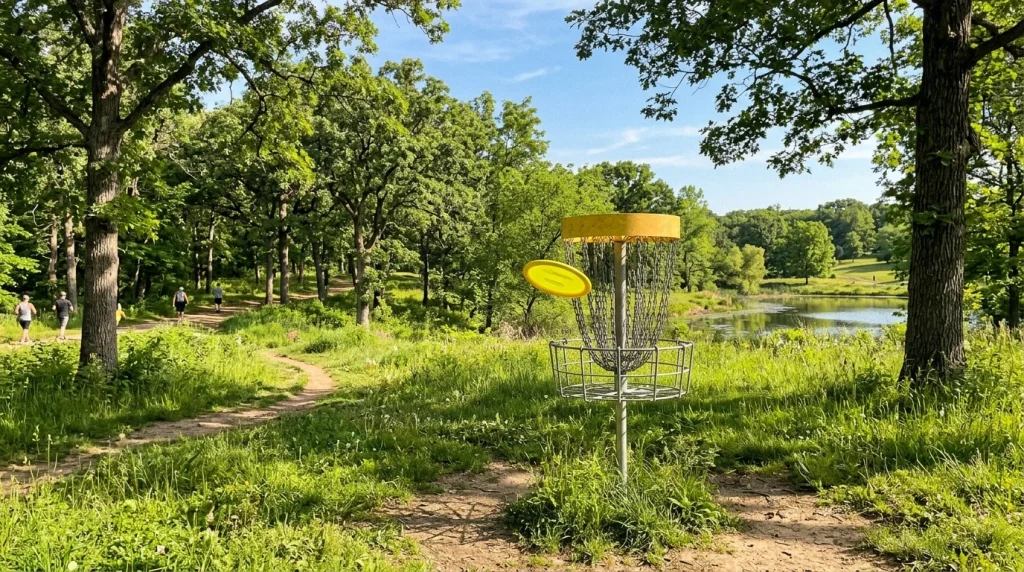
Standardized championship courses feature Professional Disc Golf Association (PDGA) approved targets equipped with heavy dual-layer galvanized chain configurations designed to catch high-velocity putts without bounce-outs. High-visibility powder-coated bands (frequently safety yellow or high-contrast orange) help throwers acquire the target visually from 400 feet down fairways obscured by tree limbs. Community beginner courses frequently utilize single-layer chain targets or older permanent fixtures that demand softer touch putting to prevent chain blow-throughs.
3. Fairway Maintenance, Rough Management & Signage
Premier courses provide detailed tee signage displaying accurate laser-measured distances from multiple tee locations, clear dogleg diagrams, defined out-of-bounds (OB) boundaries, hazard zones, and directional pointers toward the next tee pad. High-density rough management ensures discs remain retrievable without excessive searching. Courses situated in thorn-heavy brambles or poison ivy thickets require deliberate line selection to avoid lost equipment and skin irritations.
Essential Tools for Locating Disc Golf Courses Near You
Modern disc golf navigation relies on digital mapping, mobile scorekeeping directories, and community course updates. Leveraging these specialized platforms provides granular information that general navigation apps omit.
- Digital Course Directories: Dedicated mobile course finders display hole-by-hole reviews, layout variants (short vs. long tees), parking fee notices, seasonal basket positions, and recent condition reports logged by local players within the last 24 hours.
- Satellite Imagery Auditing: Reviewing aerial satellite imagery allows you to inspect fairway width, tree canopy density, water hazard proximity, and elevation gradients before traveling to an unfamiliar course.
- Local Club Forums & Social Groups: Regional disc golf clubs coordinate weekly random-draw doubles, bag tag challenges, handicap leagues, and volunteer maintenance workdays that provide real-time updates on fallen trees, wet fairways, or scheduled mowing.
- State Park Directories: Many regional departments of natural resources maintain active disc golf facility listings, detailing vehicle pass requirements, camping options, and seasonal availability.
Terrain Types You Will Encounter on Local Courses
Course architecture is profoundly influenced by local geography. Understanding how distinct course styles challenge your disc arsenal allows you to pack the right molds before stepping onto the first tee.
Open Parkland Courses
Open parkland layouts are typically situated on manicured municipal turf with scattered mature trees. Wind reads become the governing factor on these tracks. Headwinds lift understable discs into unintended rollers, while crosswinds require angle adjustments on hyzer and anhyzer lines. Carrying dependable overstable fairway drivers and utility approach discs is essential for maintaining accuracy across breezy park expanses.
Heavily Wooded Tunnel Courses
Wooded courses demand technical precision, low-ceiling line control, and scramble versatility over raw arm speed. Fairways can narrow to gaps of 10 to 15 feet between mature hardwoods. A single tree kick can send a disc 50 feet into dense brush, requiring players to execute patent-pending throws, forehand rollers, or standstill push putts. Neutral midranges and beat-in fairway drivers that hold straight flat lines without late aggressive fade are the foundation of success in the woods.
Elevation-Heavy Mountain and Valley Tracks
Significant uphill and downhill grade changes warp disc flight physics. Throwing uphill effectively increases hole distance, causing discs to fly more overstable and stall early if thrown nose-up. Conversely, throwing downhill increases airtime and relative airspeed, causing neutral discs to turn over and carry 50 to 100 feet past target baskets. Adjusting disc selection by stepping down in stability for uphill shots and stepping up in stability for downhill tee shots is crucial on undulating terrain.
Course Etiquette and Local Playing Guidelines
When playing a new disc golf course in your surrounding area, adhering to regional etiquette preserves course access and ensures safety for all park patrons.
- Yield to Pedestrians: Disc golf courses situated in shared municipal parks require strict vigilance. Always yield the right of way to walkers, joggers, cyclists, and park visitors before beginning your throwing motion. Never throw when there is any possibility of a disc striking a bystander.
- Never Throw Into a Blind Fairway: If the target basket is obscured by dense foliage, doglegs, or elevation changes, walk ahead to verify the landing zone is completely clear before throwing. A spotter on blind holes protects both fellow players and non-playing park visitors.
- Pack It In, Pack It Out: Respect park stewardship by removing all personal trash, retrieving errant discs from water hazards where safely accessible, and avoiding damage to living trees. Do not break branches or alter the natural environment to create a cleaner throwing lane.
- Let Faster Groups Play Through: If a solo player or faster card catches up to your group, politely wave them through at the next tee pad to maintain smooth course flow and reduce bottleneck delays.
- Respect Course Closures and Quiet Hours: Many public parks enforce dawn-to-dusk operating hours. Refrain from playing during posted closed hours to prevent neighborhood noise complaints that can jeopardize community course access.
Recommended Starter Setup for Local Rounds
When scouting a new venue, carrying a streamlined selection of discs ensures adaptability across varied terrain without the burden of an oversized tournament bag. Understanding disc specifications and flight characteristics helps tailor your setup to local topography.
| Disc Category | Primary Role | Recommended Stability | Fairway Scenario |
|---|---|---|---|
| Beaded Putter | Circle 1 Putting & Straight Approaches | Neutral / Stable | Inside 66 feet & gentle touch shots |
| Neutral Midrange | Controlled Placement & Tunnel Shots | Straight to slight fade | Tight wooded fairways under 280 feet |
| Understable Fairway Driver | Turnover Lines & Hyzer Flips | Understable (-2 Turn) | Low-ceiling lines & tailwind drives |
| Overstable Control Driver | Headwind Resistance & Reliable Fade | Overstable (0 Turn, 3 Fade) | Dogleg corners & open field crosswinds |
Navigating Course Amenities and Accessibility
Beyond tee pads and baskets, the overall infrastructure of a disc golf facility greatly impacts player comfort during extended multi-round days. When reviewing potential courses, consider whether the venue provides adequate parking capacity, clean restroom facilities, shaded pavilion areas, and potable drinking water stations. In summer months, playing 36 holes in high temperatures without reliable on-course water sources can quickly turn an enjoyable afternoon into a physical endurance test.
Accessibility is another crucial factor for community growth. Many modern layouts now incorporate ADA-compliant paved pathways connecting tee pads and viewing areas, allowing players of all physical capabilities to participate. Looking for courses with multiple tee pads and mixed pin locations also ensures that players of disparate skill levels can share a card while enjoying an appropriately scaled challenge.
Frequently Asked Questions About Local Disc Golf Courses
Are most public disc golf courses free to play?
Yes. The vast majority of municipal disc golf courses located in public township and county parks are completely free to access. Some state parks or specialized private facilities charge modest daily greens fees (typically five to fifteen dollars) to fund turf maintenance, tee pad upgrades, and dedicated amenities.
How long does an 18-hole round take?
A standard 18-hole round played by a solo player generally takes between 60 and 90 minutes. A recreational card of three to four players typically completes an 18-hole layout in approximately 2 to 2.5 hours depending on fairway length and course traffic.
Can I play disc golf with regular frisbees?
While beginners can practice basic throwing form with standard recreational frisbees, purpose-built disc golf discs are engineered with aerodynamic beveled rims that generate significantly higher rotational stability, velocity, and distance required for navigating modern course layouts. Learn more about playing with traditional frisbees versus golf discs.
What should I do if my disc lands in a water hazard?
Safety is always paramount. Only attempt retrieval if the disc is clearly visible and within safe reach from the bank using a telescopic disc retriever pole or stick. Never wade into deep, murky, or fast-moving water. Many courses feature community disc dropboxes where recovered discs are returned to their owners using phone numbers written on the inner rim.
Get our latest guides, news, and insights highlighted in your Google Search & AI Overviews.