✨ This article was AI edited. Editorial responsibility: Spilmandgc.org.
Produced with AI. This article was artificially generated. Editorial responsibility: Spilmandgc.org.
Nearest disc golf course refers to the closest geographic facility equipped with permanent disc golf targets and designated tee areas relative to your real-time location. Finding your nearest course involves calculating driving radius, checking opening hours, course difficulty ratings, and verifying layout availability before departing for a round.
When the impulse strikes to get outside and throw a round, pinpointing the nearest disc golf course with accurate drive times and up-to-date facility details saves valuable daylight. Whether you have 45 minutes for a quick lunch-break practice session or an entire afternoon to tackle 18 holes, knowing what to expect from your closest disc golf venue ensures a seamless experience.
How to Quickly Locate Your Nearest Disc Golf Course
Locating the most accessible disc golf facility requires evaluating transit times, parking access, and course layouts. Not all courses near your location serve the same purpose; a compact 9-hole school course offers completely different utility than a full-scale championship tract.
| Course Profile | Average Holes | Average Distance | Typical Round Time | Best Suited For |
|---|---|---|---|---|
| Pocket / Neighborhood Park | 6 to 9 | 150 – 220 ft | 30 – 45 mins | Quick putting practice & beginners |
| Municipal Park Standard | 18 | 250 – 350 ft | 75 – 100 mins | Weekly rounds & casual cards |
| County / State Nature Reserve | 18 to 27 | 350 – 600+ ft | 2 to 3 hours | Full-day excursions & tournament play |
1. Radius and Commute Considerations
In metropolitan areas, the closest course geographically may not be the quickest to reach during peak traffic hours. Utilizing live traffic GPS routing to compare commute times between a 9-hole layout 5 miles away and an 18-hole park 10 miles away via the highway often reveals faster access to the larger facility.
2. Checking Current Course Status Before Leaving
Before getting in the car, verifying current course status is essential. Public park courses frequently host seasonal events, maintenance shutdowns, or local tournaments that restrict public play. Checking digital community logs ensures you do not arrive at a course only to find the fairways occupied by a cross-country race or private club championship.
3. Evaluating Course Layout and Time Availability
Match your course selection to your available schedule. If you have only one hour before sunset, heading to an expansive wooded 18-hole layout with dense rough risks losing discs in dim lighting and racing against nightfall. In contrast, a 9-hole community loop provides an enjoyable, stress-free round with plenty of daylight to spare.
Essential Gear to Keep Ready in Your Vehicle
To capitalize on spontaneous opportunities to play your nearest disc golf course, keeping a compact “grab-and-go” kit in your car trunk ensures you are always prepared without hauling bulky tournament gear.
- Three-Disc Essentials: Keep a reliable putter, a neutral midrange, and a dependable fairway driver in a small bag. These three core molds cover 90% of fairway demands on standard public courses.
- Course Towel with Carabiner: Early morning rounds encounter heavy dew, while summer rain showers can slick discs and hands. A microfiber towel restores grip instantly.
- Proper Outdoor Footwear: Running shoes or lightweight trail shoes with aggressive rubber tread provide the traction needed on wet concrete tee pads and sloping dirt fairways. Avoid playing in smooth-soled street shoes or sandals.
- Hydration and Sun Protection: Keep a reusable water bottle, sunscreen, and insect repellent stored in your vehicle so you never have to delay a spontaneous round to hunt for convenience stores.
Course Navigation and First-Time Exploration Tips
Arriving at an unfamiliar disc golf course can sometimes feel disorienting, particularly on older layouts where signage has weathered over time. Following these practical scouting methods ensures smooth navigation:
- Start at the Course Kiosk: Most courses feature a main information bulletin board near the primary parking lot with a full course map. Take a quick photo of the course map on your smartphone before heading toward Hole 1 so you have an offline reference.
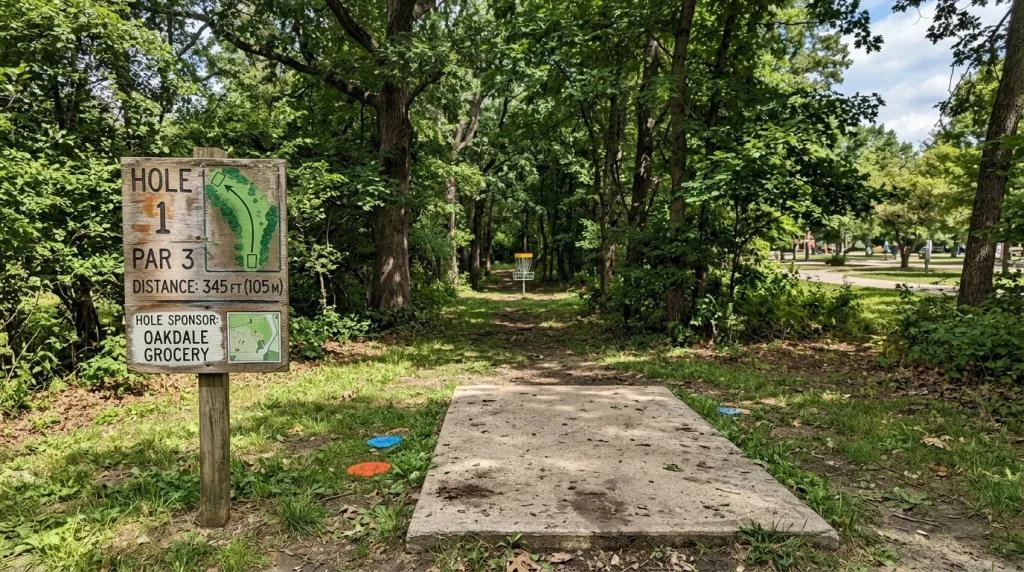
- Locate the First Tee Box: Tee 1 is almost always situated within a short walking distance of the parking lot and practice basket. Look for concrete pads accompanied by a tee sign or distance marker.
- Follow the Next Tee Indicators: Experienced course designers install directional arrows either on the bottom of target baskets or on wooden fairway stakes pointing toward the next tee pad. Look for these visual markers after tapping out your putt.
- Scout Before Throwing on Blind Fairways: If you cannot see the basket from the tee due to dense trees or sharp doglegs, walk forward into the fairway to locate the pin and observe potential hazard areas before throwing.
Safety and Park Courtesy on Closest Courses
Community courses in neighborhood parks require a heightened awareness of shared park users. Practicing proactive safety protects the reputation of the sport and preserves public park access for future generations:
- Always Give Pedestrians the Right of Way: Never throw a disc when a walker, dog owner, or child is within range of your fairway or errant kick zone. Wait patiently until they have cleared the area completely.
- Never Climb Fences for Out-of-Bounds Discs: If your disc crosses a private property fence bordering a park course, respect homeowner boundaries. Knock on the door and ask permission, or leave a polite note requesting the disc back.
- Heed Inclement Weather Warnings: Open fairways and tall metal baskets present lightning hazards during summer thunderstorms. If you hear thunder or see lightning, immediately seek shelter in your vehicle or a designated park pavilion.
Understanding Hole Terminology and Rules
When playing local courses, understanding common terminology enhances your course management. For example, learning what a mandatory (mando) means on the course prevents penalty strokes on tricky holes designed around pedestrian walking paths or private property borders. Likewise, understanding how par is calculated across different fairway lengths helps you set realistic scoring expectations on every hole.
| Term | Definition | Impact on Play |
|---|---|---|
| Tee Pad | Designated starting area for each hole | All supporting points must be within the pad at release |
| Mandatory (Mando) | Course boundary rule forcing discs past a specific marker | Missing the marked side incurs a 1-stroke penalty |
| Out-of-Bounds (OB) | Designated non-playable areas (roads, sidewalks, water) | 1-stroke penalty; play from last in-bounds point |
| Circle 1 (C1) | 10-meter (32.8 ft) radius surrounding the basket | Players must maintain balance behind lie until disc settles |
Frequently Asked Questions About Nearest Disc Golf Courses
How do I know if the nearest course is suitable for beginners?
Look for courses designated as 9-hole recreational layouts or courses with average hole distances under 250 feet with wide fairways and minimal water hazards. Courses with high par ratings and heavy forest corridors can be frustrating for players still developing directional control.
Can I play the nearest disc golf course during the winter?
Yes. Disc golf is an all-season sport played year-round across North America and Europe. In winter, dress in moisture-wicking layers, tape bright ribbons to discs when playing in snow, and watch your footing on icy concrete tee pads. Review our guide on how to play disc golf in the snow for cold-weather tips.
Do I need a tee time reservation for a local disc golf course?
Almost all public municipal disc golf courses operate on a first-come, first-served basis with no tee times required. Simply walk up to Tee 1, allow any active group to clear the fairway, and begin your round. High-end private championship courses or resort complexes may require advance booking through their pro shop.
Get our latest guides, news, and insights highlighted in your Google Search & AI Overviews.