✨ This article was AI edited. Editorial responsibility: Spilmandgc.org.
Produced with AI. This article was artificially generated. Editorial responsibility: Spilmandgc.org.
Where to play frisbee golf near me refers to locating public and private disc golf courses within your local vicinity suitable for recreational frisbee and disc golf play. Finding accessible venues involves identifying municipal park layouts, community college courses, church campuses, and dedicated pay-to-play disc golf complexes that welcome both beginners throwing recreational frisbees and experienced disc golfers.
If you grew up tossing catch frisbees in backyard picnics or college quads and want to know where to play frisbee golf near you, transitioning to organized courses provides an exciting, low-cost outdoor sport. While veteran competitors refer to the sport as disc golf, hundreds of municipal parks across the country feature target baskets explicitly installed for casual community frisbee play.
Best Venue Types for Playing Frisbee Golf Locally
When searching for places to play, understanding the different facility types helps you pick a course that fits your physical preferences and equipment. Recreational catch frisbees fly differently than beveled golf discs, making open, shorter layouts much more enjoyable for casual outings.
| Venue Category | Typical Hole Count | Average Fairway Length | Cost / Fees | Frisbee Suitability |
|---|---|---|---|---|
| Municipal Township Park | 9 to 18 Holes | 175 – 275 ft | Free Public Access | Excellent (Open & Gentle) |
| Elementary / Middle School Campus | 6 to 9 Holes | 120 – 200 ft | Free (Outside School Hours) | Ideal for Beginners & Kids |
| County Conservation Area | 18 Holes | 280 – 400 ft | Vehicle Parking Fee ($3-$7) | Moderate (Dense Foliage) |
| Private Pay-to-Play Resort | 18 to 36 Holes | 350 – 650+ ft | $10 – $20 Day Pass | Better with Dedicated Golf Discs |
1. Public Township Parks
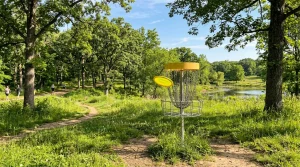
Public parks are the backbone of community frisbee golf. Township parks typically install 9 or 18 metal target baskets across shared recreational spaces alongside walking trails, soccer fields, and picnic shelters. Because these courses are designed for broad community enjoyment, fairways are usually wide and grass is mowed weekly, making it easy to find errant throws without getting lost in thorny underbrush.
2. School and University Campuses
Many community colleges, universities, and secondary schools feature beginner-friendly 9-hole layouts on their athletic grounds. These courses feature shorter distances between 120 and 220 feet, making them perfect for learning throwing mechanics with standard recreational catch discs. Keep in mind that campus courses are usually open to the general public only outside standard school operational hours, such as evenings, weekends, and summer breaks.
3. Dedicated Pay-to-Play Facilities
If you want a manicured golf experience with immaculate concrete tee pads, pro shop disc rentals, and on-site clubhouses, dedicated disc golf complexes provide top-tier recreation. While traditional public parks are free, paying a modest greens fee grants access to championship-level fairways, pristine turf, and dedicated practice putting greens.
Can You Play Frisbee Golf with Regular Catch Frisbees?
A common question from newcomers searching for local courses is whether traditional beach frisbees or Ultimate discs are acceptable on the course. You can certainly start playing with whatever plastic disc you have available in your garage. However, understanding the physical differences between recreational catch discs and specialized golf discs will help you manage expectations on the fairway. Review our in-depth comparison on playing with traditional frisbees versus golf discs.
- Rim Profile & Aerodynamics: Traditional frisbees feature deep, blunt outer rims that generate high aerodynamic drag, causing them to glide slowly and hover. Dedicated golf discs feature sharp, beveled leading edges that cut through wind and travel with much higher velocity.
- Distance Capabilities: A clean throw with a standard catch frisbee typically tops out around 150 to 200 feet. In contrast, golf drivers and midranges are weighted to achieve distances of 250 to 400+ feet with comparable effort.
- Target Basket Interaction: Modern metal chain baskets are designed to catch heavy golf discs (typically 150 to 175 grams). Lightweight, oversized frisbees can sometimes bounce off the outer chains if thrown with excessive speed.
How to Scout and Navigate Your First Local Course
When visiting a local course for the first time, taking a few minutes to orient yourself before throwing Hole 1 ensures an enjoyable round without unnecessary backtracking:
- Locate the Course Map Kiosk: Most park courses feature an information sign near the main parking lot displaying the complete course map, individual hole pars, and walking paths. Take a photo of the layout with your phone.
- Identify the Starting Tee Markers: Look for concrete pads, artificial turf strips, or wooden ground markers numbered “1”. Tee boxes are designed to give throwers a clean, level surface for their run-up.
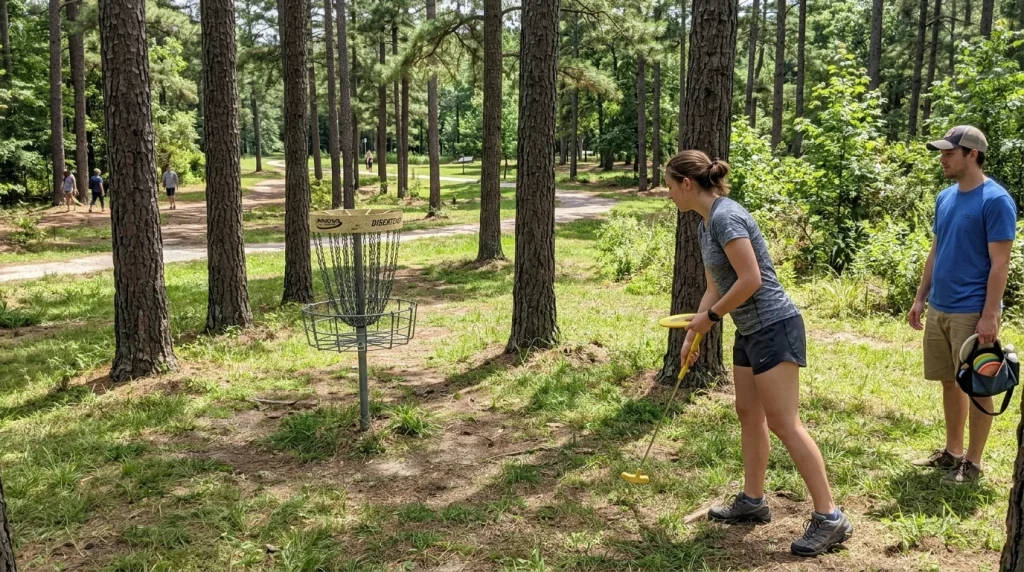
- Spot the Corresponding Target Basket: Look down the fairway for the metal pole and chain assembly. Target baskets usually have number plates or brightly painted bands on top that match the tee sign.
- Watch for Pedestrians and Park Users: Because many courses occupy multi-use municipal parks, non-playing pedestrians frequently cross fairways. Always pause and wait until walkers, joggers, and children are completely clear before beginning your throw.
Course Etiquette for Casual Players
Maintaining positive relationships with municipal park staff and fellow players ensures courses remain open and free for everyone. Adhering to basic rules of play—such as those detailed in the official PDGA rules overview—ensures a safe and welcoming atmosphere:
- Never Throw Blind: If doglegs or rolling hills block your view of the basket, walk forward to confirm the landing area is clear before throwing.
- Respect Nature and Park Trees: Never break branches, snap saplings, or carve into tree trunks to open up a throwing lane. Course obstacles are part of the game design.
- Carry Out All Trash: Leave the course cleaner than you found it. Pack out empty beverage cans, snack wrappers, and personal waste.
- Allow Faster Groups to Play Through: If a smaller or faster group catches up to your card, politely pause at the next tee pad and wave them ahead to keep course traffic moving smoothly.
Frequently Asked Questions About Where to Play Frisbee Golf
Is playing frisbee golf in public parks free?
Yes. Approximately 90 percent of disc golf courses located in public municipal and county parks are 100 percent free to play. You simply bring your own discs, park your car, and walk up to the first tee.
Do I need special equipment to play a casual round?
No. Beginners can complete a casual 9-hole round with a single catch frisbee or a beginner golf disc. As you progress, adding a dedicated putter and midrange from a local sporting goods shop will significantly improve your directional accuracy and control.
How do I find out if a park course is crowded?
Most public courses experience peak traffic during sunny weekend afternoons and weekday evenings between 5:00 PM and 7:00 PM when local leagues play. Arriving on weekday mornings or early afternoons ensures wide-open fairways and unhurried play.
Get our latest guides, news, and insights highlighted in your Google Search & AI Overviews.